
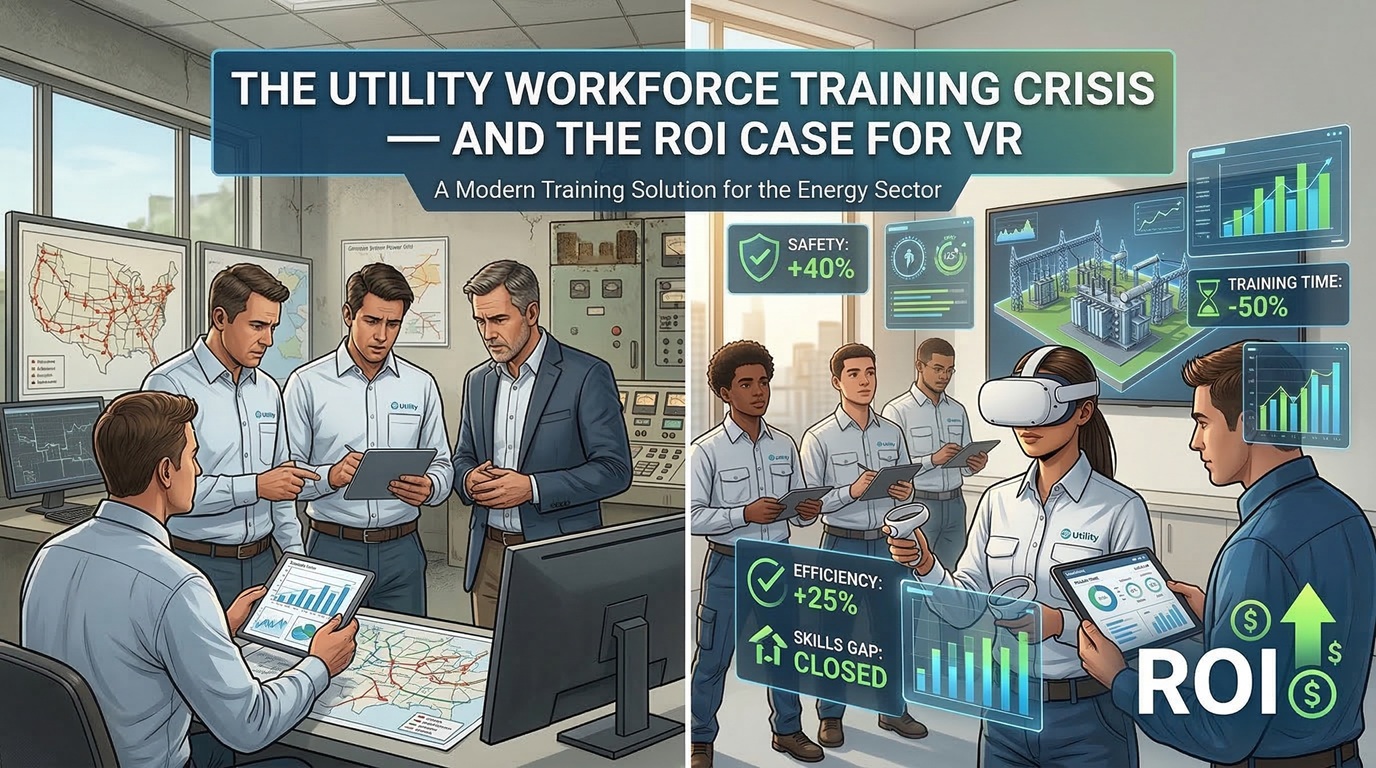
Your most experienced linemen, substation operators, and field technicians are retiring. The institutional knowledge walking out the door took decades to build. The new cohort coming in needs to get competent — fast. Here's how leading utilities are using VR simulation training to close that gap and prove the ROI.
The training programs that most utilities still rely on — instructor-led classrooms, printed SOPs, occasional equipment walkthroughs — were designed for a different era. They don't scale, they don't replicate the stress of a live scenario, and the research on retention after 90 days is not encouraging.
Virtual reality training changes that equation. This post breaks down exactly how utilities and energy operators are measuring the return on investment when they deploy VR simulation for SOP training — and the metrics that actually move the needle with finance, operations, and the board.
Want to see the numbers for your organization?
→ Run Your Free ROI Estimate1. The Scale of the Problem Utilities Are Facing
Before getting into ROI methodology, it's worth understanding the scope of what the energy sector is actually dealing with. The workforce challenge isn't a regional blip — it's a structural shift with real financial consequences.
The "great crew change" in traditional energy — the retirement wave the industry has seen coming for years — is now hitting in earnest. Baby boomers who built careers on switchgear, turbines, and transmission lines are exiting, and the tribal knowledge they carry doesn't transfer through a manual.
According to the U.S. Census Bureau (2025), utilities and manufacturing rank among the sectors with the highest share of workers over age 55, accelerating the knowledge-loss risk industry-wide. For utilities specifically, that cost shows up as extended time-to-competency for new hires, higher incident rates among less experienced workers, increased reliance on expensive senior staff for supervision, and compliance exposure during audits.
VR allows organizations to encode years of field expertise — including edge cases, decision points under pressure, and equipment-specific failure modes — into repeatable simulation scenarios. A new substation operator can experience in hours what would take years to encounter in the field.
2. Why Traditional Utility Training Fails the ROI Test
Most utilities don't lack training programs. They lack training programs that work at scale. Here's what the economics of traditional instructor-led training actually look like when you add them up.
The hidden costs of equipment-based training
Running hands-on training on live equipment means scheduling around operational windows, tying up assets that have a cost of downtime, and limiting group sizes to whatever the equipment configuration allows. For high-voltage switching procedures or bucket truck operations, that often means one or two trainees per session. The cost per learner is rarely calculated in full — and when it is, the number surprises most training managers.
Instructor dependency
Your most qualified trainers are also your most operationally valuable people. Every hour a senior engineer or master lineman spends running a training session is an hour they're not doing what you hired them for. At scale, this represents significant hidden cost — particularly during high-demand periods when training needs and operational demands peak simultaneously.
Retention is the real problem
PWC research on immersive learning found that VR-trained employees retain information at dramatically higher rates than those trained through e-learning or classroom instruction. At 90 days post-training, traditional methods deliver roughly 10% knowledge retention. VR training consistently delivers 75% or higher. In a sector where the cost of forgetting a procedure is a safety incident — not a performance issue — that gap has a measurable dollar value.
| Metric | VR Training Impact |
|---|---|
| Knowledge retention at 90 days (traditional ILT) | ~10% |
| Knowledge retention at 90 days (VR training) | 75%+ |
| Course completion speed vs. e-learning | 4× faster (PWC) |
| Cost per learner reduction (VR vs. ILT) | 40–60% |
| Incident rate reduction post-VR deployment | 40–70% |
| On-job error rate reduction | 20–40% |
3. The Four ROI Categories That Matter for Utilities
ROI measurement for VR training in the energy sector falls into four buckets. Each has a hard dollar value — and each is measurable with data your operations team already collects.
Category 1: Safety and incident reduction
This is typically where the largest financial returns are concentrated in utilities. The average cost of a workers' compensation claim in the energy sector sits around $40,000 — and that's before factoring in indirect costs: incident investigation, regulatory reporting, reputational impact, and productivity loss during recovery. High-severity incidents carry costs an order of magnitude higher.
VR training's impact on incident frequency is well-documented. Immersive simulation for high-risk procedures — lockout/tagout, high-voltage switching, elevated work in bucket trucks, emergency shutdown sequences — allows workers to experience failure modes and correct their behavior before they encounter them in the field.
"VR Vision's immersive SOP simulation trained over 2,000 field technicians across bucket truck operations and energy SOPs — delivering measurable results within 90 days of deployment."
Toronto Hydro | 2,000+ technicians trained | Results measured at 90 days
→ View full energy & utilities program details
To calculate dollar value: Take your rolling 12-month incident count, apply the estimated reduction percentage (40–70% is typical), and multiply by your average cost per incident. That single line item often justifies the entire program cost before safety, productivity, and compliance gains are even counted.
Calculate your safety ROI
→ Model Your Incident Reduction SavingsCategory 2: Productivity and time-to-competency
Every week a new technician isn't fully competent is a week they're operating at partial capacity, requiring increased supervision, and contributing to errors. Time-to-competency is one of the clearest ROI signals available — and VR training consistently cuts it by 30–50%.
VR also enables scenario repetition that isn't practical with physical equipment. A trainee can run a high-voltage switching sequence fifty times in a virtual environment before touching live equipment — building the procedural muscle memory that normally takes months to develop on the job. Research from GTI Energy and Oberon Technologies found that trainees encountering VR simulations developed years of field experience in hours, specifically because the scenarios included rare failure modes and emergency situations that would take years to encounter naturally.
Calculation: Take your average time-to-full-competency under current training, reduce it by 30–50%, multiply by your new hire count, and apply a value per productive day. For large utilities onboarding dozens of technicians annually, this number is material.
Category 3: Training delivery efficiency
This is often the easiest cost to calculate and the first one finance teams want to see. Compare the fully-loaded cost of your current training program — instructor hours, equipment time, facility costs, travel, and administrative overhead — against the cost of deploying VR. The per-learner cost advantage typically ranges from 40–60%.
More importantly, VR training scales non-linearly. Once content is built, the marginal cost of training additional learners approaches zero. For utilities with distributed workforces, multi-site operations, or seasonal hiring cycles, this is a structural advantage.
A utility with 500 annual learners at $1,200/learner under traditional ILT spends $600,000/year on training delivery. At a 50% per-learner reduction with VR, that's $300,000 in annual savings — against a typical VR program investment of $50,000–$150,000. That's year-one ROI before safety and productivity gains are counted.
Category 4: Compliance and regulatory performance
For utilities, compliance isn't optional — it's existential. NERC CIP standards, OSHA 1910.269 for electrical work, and a growing set of grid modernization requirements create mandatory training obligations. Audit failure or regulatory violation carries both direct cost (fines, remediation) and indirect cost (operational disruption, executive attention, reputational exposure).
VR training delivers two compliance advantages. First, it provides a documented, repeatable training record — every simulation run is logged, scored, and timestamped, creating an audit trail that instructor-led sessions rarely match. Second, it improves SOP adherence scores, because workers internalize procedures through practice rather than passive reading.
Research published in Scientific Reports (2026) on VR training in high-voltage electrical substations found that VR-trained workers demonstrated measurably better decision-making under pressure and higher rates of correct procedure adherence — precisely the behavior that determines audit outcomes and incident rates in the field.
4. How to Structure the Measurement
The framework above only works if measurement is set up correctly. Here's the methodology that holds up to finance and executive scrutiny.
-
Establish a hard baseline before deployment.
Pull 12 months of pre-VR data on: incident frequency and severity, training cost per learner, time-to-competency for key roles, SOP adherence scores from field audits, and near-miss incident counts. This is your control dataset. Without it, you're estimating rather than measuring. -
Run a control group comparison.
Train one cohort via VR and one via traditional methods. Track both groups at 30, 60, and 90 days, and again at 6 and 12 months. The delta between groups is your attributable gain — the number that holds up in a board presentation. -
Capture what traditional accounting misses.
Equipment downtime during hands-on sessions. Senior staff time pulled for supervision. The productivity gap during ramp — errors, rework, the oversight load on experienced colleagues. Map these costs before deployment and the ROI case becomes significantly stronger. -
Model near-miss avoidance.
Most utility operations teams have near-miss logs. If VR-trained employees show a measurable reduction in near-misses, apply a conversion probability to model avoided serious incidents. This is where the largest ROI numbers emerge — and it's the most defensible safety argument for the program.
Ready to build your own ROI model?
→ Build Your ROI Model — Free Calculator5. What Utility-Specific VR Training Actually Looks Like
A common misconception is that VR training is a generic product that gets adapted to any industry. The programs that deliver measurable ROI in utilities are built around the specific procedures, equipment configurations, and risk profiles of your operations. The highest-value applications in the energy and utilities sector include:
- High-voltage switching procedures and LOTO — the scenarios with the highest consequence-of-error and the greatest difficulty replicating safely in traditional training
- Bucket truck and aerial lift operations — enabling repetition of elevation procedures without equipment availability constraints or risk
- Substation operations and fault response — including emergency shutdown sequences and decision-making under simulated stress conditions
- Contractor and multi-crew onboarding — standardized site orientation and SOP walkthroughs that run at any location without trainer availability
- Emergency operating procedures — scenarios that would be dangerous or logistically impossible to replicate in live training
360° video simulation: Best for onboarding, safety walkthroughs, and SOP reinforcement. Fast to produce and highly scalable. Typical range: $25K–$50K, 4–6 weeks.
Fully interactive simulation: Best for equipment operations, hazardous workflows, and multi-step technical procedures. Higher interactivity, measurable competency, repeatable evaluation.
VR Vision's energy and utilities training library — built in partnership with clients including Toronto Hydro, Meta, and Siemens — covers these use cases across both deployment formats. Explore the full energy & utilities training catalogue →
6. Getting Started: The Pilot Framework
The utilities that see the fastest ROI from VR training don't try to boil the ocean. They start with a single high-value workflow — one with high cost-of-error, limited hands-on access, or a documented compliance gap — and prove the model before scaling.
- Select one SOP: Choose a procedure where traditional training has documented limitations — a high-consequence task, a scenario that's rare in the field, or a process where turnover repeatedly resets competency.
- Define your baseline metrics: Incident count, time-to-competency, training cost per learner. These are your "before" numbers.
- Deploy and measure: Run the VR cohort alongside a traditional training cohort. Track both at 30/60/90 days.
- Quantify and present: Calculate the dollar value of the delta across safety, productivity, and training efficiency. This becomes your business case for full deployment.
Most VR Vision energy sector pilots produce enough ROI data within 90 days to justify full-scale deployment. The key is measuring correctly from day one.
Calculate your organization's VR training ROI
→ Run Your Free ROI EstimateQuestions? Talk to the VR Vision team →
7. Frequently Asked Questions
How long does it take to see ROI from VR training in a utility company?
Most utility clients see measurable ROI signals within 90 days of VR training deployment — primarily through reduced incident frequency, lower training cost per learner, and faster time-to-competency for new hires. Full-year financial modeling typically shows positive ROI in year one when safety savings are included in the calculation.
What does VR training cost for a utilities workforce program?
Utility VR training programs typically range from $25,000–$50,000 for 360° video-based SOP simulations to $50,000–$150,000+ for fully interactive, multi-step procedural simulations. The per-learner cost generally drops 40–60% compared to traditional instructor-led training when calculated over a full year's learner volume.
Can VR training meet NERC CIP and OSHA 1910.269 compliance requirements?
Yes. VR training platforms used in enterprise utility deployments provide logged, timestamped, scored training records that satisfy audit trail requirements. Simulation content can be mapped directly to specific NERC CIP and OSHA 1910.269 procedure elements. VR training typically improves audit pass rates by improving SOP adherence in the field.
How does VR training compare to traditional hands-on equipment training for high-voltage procedures?
VR training provides unlimited repetition in a zero-risk environment, which is particularly valuable for high-voltage switching, LOTO procedures, and emergency shutdown sequences. Research on utility VR programs consistently shows 75%+ knowledge retention at 90 days versus approximately 10% for traditional instruction. VR-trained workers also demonstrate better decision-making under pressure in documented case studies.
What utility SOPs are best suited to VR training?
The highest-ROI VR training applications in utilities are procedures with high consequence-of-error and limited safe hands-on practice opportunities: high-voltage switching, lockout/tagout (LOTO), bucket truck and aerial lift operations, substation fault response, emergency operating procedures, and contractor site onboarding. These are also typically the hardest and most expensive to train with traditional methods.
VR Vision is a Toronto-based enterprise VR training company with clients including Toyota, Siemens, Meta, Lenovo, and Toronto Hydro. Specializing in immersive SOP simulation for high-risk industries including energy, utilities, manufacturing, and heavy industry. Explore energy & utilities solutions →
Sources & References
- Center for Energy Workforce Development (CEWD) — Energy Workforce Fast Facts, 2025
- Manpower Group — Talent Shortage Survey, 2024
- Lightcast — Workforce Risk Outlook, 2025
- Workday — Global Workforce Report, 2025
- PwC — The Effectiveness of Virtual Reality Soft Skills Training in the Enterprise, 2020
- GTI Energy / Oberon Technologies — VR Training for Gas Utilities, 2024 (oberontech.com)
- Scientific Reports — Virtual reality to enhance risk management and safety in electrical substations, 2026
- U.S. Census Bureau — U.S. Workforce is Aging, 2025