What Does VR Training Cost? Real Price Ranges for 2026
What enterprise VR training really costs in 2026, what drives the price, and how to plan your budget. Based on VR Vision’s published list pricing.


The short answer
A custom VR training project averages about $120,000. A single custom 3D module runs $65,000 to $120,000, and an interactive 360 video module runs $30,000 to $60,000. Licensing a pre-built module costs $1,000 to $15,000 per module per year, and a starter program of six licensed modules plus the training platform runs about $75,000 in year one.
All amounts are in Canadian dollars and come from VR Vision’s 2026 list pricing. Other vendors will differ.
Key takeaways
- The delivery model sets the price. Licensing a pre-built module and building a custom 3D one differ in cost by roughly 100 times.
- A few factors move the number most. Format, whether CAD or a digital twin already exists, fidelity, branching and faults, and how many languages you need.
- Budget for the whole lifecycle. Headsets, the training platform, integrations and maintenance add to the build cost every year.
- Start with a pilot. Pre-built modules can be in the field within 1 to 2 months. A custom pilot takes 3 to 4 months.
VR training costs at a glance
There are five common ways to get VR training. Each suits a different kind of procedure and budget.
| Approach | Typical cost (CAD) | Time to first pilot | Best for |
|---|---|---|---|
| License a pre-built module | $1,000 to $15,000 per module per year | 1 to 2 months | Standard procedures such as safety, lockout and common equipment |
| Adapt a pre-built module | $10,000 to $20,000 per module, plus the license | Shorter than a custom build | Standard procedures on your own equipment |
| Custom interactive 360 video | $30,000 to $60,000 per module | 3 to 4 months | Real sites, observation and decision-making |
| Custom 3D (CGI) module | $65,000 to $120,000 per module | 3 to 4 months | Hands-on operation of your exact equipment |
| Self-serve authoring tools | $75,000 to $150,000 in year one, mostly internal team time | Depends on your team | Simple scenarios built by in-house designers |
A typical custom project averages about $120,000. The final number depends on how many procedures you cover, how much of the content already exists, and how closely the training has to match your real equipment.
What a full program costs
The module is only part of the budget. These are the line items a complete program usually includes, from VR Vision’s 2026 list pricing.
| Line item | What it covers | Cost (CAD) |
|---|---|---|
| Pre-built module license | A ready-to-deploy module with guided and evaluation modes, and content updates during the term | $1,000 to $15,000 per module per year |
| Training platform | Remote assistance, analytics, trainer dashboard and course management for 10 trainer accounts and up to 100 headsets | $25,000 per year |
| Starter program (example) | Six licensed modules, the platform, setup, branding and train-the-trainer | About $75,000 in year one, then about $60,000 per year |
| Adapting a pre-built module | Changes to match your specific equipment or procedure | $10,000 to $20,000 per module |
| Custom 3D (CGI) module | One procedure built to your equipment: design, 3D assets, interactions, guided and evaluation modes, QA and deployment | $65,000 to $120,000 per module |
| Custom interactive 360 video module | Filmed on site, with decision points and assessment built in | $30,000 to $60,000 per module |
| New equipment digital twin | Modeling a piece of equipment and its environment from scratch when no model exists | About $50,000, one time |
| On-site capture | A site visit to capture equipment, environment and workflow | $10,000 per visit, or about $20,000 for one visit covering several modules |
| Integrations | LMS integration, and single sign-on through Microsoft Azure | $8,500 for LMS; $25,000 for Azure SSO |
| Multi-user add-on | Crews training together in the same scenario | +25% of the annual module license |
| Maintenance and support | Unlimited bug fixes, 1 major and 3 minor changes per module per year, OS and firmware updates, and critical security patches within 24 hours | $10,000 to $15,000 per module per year (about 10 to 15% of build cost) |
These figures exclude your own team’s time. Subject matter expert reviews, a project owner and IT support are often the largest hidden cost of any training program, so plan for them from the start.
For a side-by-side look at how vendors price, assess and deliver, see our Industrial VR Training Buyer’s Guide.
What drives the price
Two projects with the same number of modules can differ in cost by tens of thousands of dollars. These are the factors that make the difference.
- Format. Interactive 360 video costs about half as much as a full 3D build. Learners can look around a real site and make decisions, but they can’t pick up tools or operate equipment.
- Existing CAD, BIM or digital twin. This is the biggest single swing. Providing existing 3D models can cut 3D asset creation costs by up to 50%.
- Fidelity. Matching your exact equipment costs more, especially when CAD files don’t exist and assets have to be modeled from photos and site visits.
- Branching and faults. Every fault, error path or randomized defect in evaluation mode adds build and test time.
- Subject matter expert availability. When expert reviews slip, schedules and costs slip with them.
- Languages and accessibility. Each added language means new audio, text and testing.
- Multi-user scenarios. Crews training together add networking and testing work.
- Reuse. Once a digital twin exists, each additional procedure on the same equipment costs far less than the first.
Where the money goes in a custom build
A custom build runs in four overlapping phases. Each one ends with a two to three week client review and quality check before the next begins.
| Phase | Planned duration | What happens |
|---|---|---|
| Client provisions | About 1.5 months | Site capture, procedure documents, equipment data and environment setup |
| Alpha release | About 2 months | Core environment and interactions built, then the first client review |
| Beta release | About 1.5 months | Full procedure, evaluation mode, and revisions from expert review |
| Final release | 2 to 3 days | Production release to headsets |
| Total | About 5.5 months | Learners are usually in a working pilot at 3 to 4 months |
Professional services
Project management keeps design, development, testing and delivery on schedule and on budget. It covers storyboarding the learner’s experience, mapping the workflow so tasks happen in the right order, and writing the design documentation every team member builds from. It also includes change management, training your trainers, and a security review with your IT team.
Digital assets: 360 video or 3D
Interactive 360 video captures a real environment on film. We shoot in 11K, in either monoscopic or stereoscopic 360. Stereoscopic video adds depth for a more lifelike result, but needs more cameras and more post-production. A 360 project moves through pre-production (storyboards, shot lists and planning), filming on site, and post-production, where the decision points and assessments are added.
3D digital twins recreate your equipment and environment so learners can handle tools and operate machinery. The work starts with reference material: either your existing CAD or BIM files, or an on-site capture using photos, LiDAR scans or point clouds. From there the team blocks out the scene, models, textures and details each asset, then optimizes everything to run smoothly on a standalone headset. Learn more about our digital twins.
Application development
This is usually the largest share of a custom build. It covers interaction design, the steps of the procedure, the user interface, multiplayer networking, animation and visual effects, localization, and sound. Each one affects how natural the training feels and how well it teaches.
Integrations
Integrations connect VR training to the systems you already use. VR Vision supports SCORM 1.2, SCORM 2004 and xAPI for LMS reporting, and single sign-on through Microsoft Azure, Okta, Google and WorkOS. LMS integration is set up on request.
Maintenance and support
Headset operating systems and firmware change often. Maintenance keeps your training working and current, with unlimited bug fixes, compatibility updates, critical security patches within 24 hours, and a set number of content changes each year.
Hardware and platform costs
- Headsets. An enterprise headset package costs about $1,000 per headset, including the standalone headset, carry case, shipping, firmware update and device management enrolment. Current deployments use the Meta Quest 3, Meta Quest 3S and PICO 4 Enterprise. No gaming PC is needed.
- Device management. Included in the headset package and delivered through ArborXR. Meta closed its Quest for Business program and stopped accepting new Horizon Managed Services subscriptions on February 20, 2026, so new fleets are managed through third-party tools.
- How many headsets. Plan for about one headset per 30 learners. That rule of thumb comes from a single large deployment of 300+ headsets serving 10,000+ technicians.
- Training platform. Vision Portal costs $25,000 per year for 10 trainer accounts and up to 100 headsets, or about $250 per headset per year. Trainers use it to launch sessions, watch what learners see in real time, and track results.
Pre-built, custom or self-serve: how to choose
Most buyers assume a custom build is the only option. It’s the top rung, not the only one.
| Approach | Choose it when | Watch out for |
|---|---|---|
| Pre-built modules | The procedure is standard across your industry and you want learners in headsets quickly at a predictable annual cost | Content may not match your exact equipment. Adapting a module closes that gap for $10,000 to $20,000. |
| Custom 3D | The equipment or procedure is unique to you, or learners need to practice hands-on operation | The highest cost and a longer timeline. Existing CAD data brings both down. |
| Custom 360 video | Realism of a real site and good decisions matter more than handling equipment | Learners look and choose, but can’t operate tools. |
| Self-serve authoring | You have instructional designers in house and need simple scenarios you can change often | You still need 3D or 360 content, and advanced interactions and multiplayer are limited. Tools are usually priced per author seat. |
Pre-built doesn’t have to mean generic
Our VR training library includes 100+ ready-to-deploy modules for utility field, substation and safety work. Each one has guided and evaluation modes, runs on Vision Portal, and supports the same single sign-on and LMS options as a custom build. You can start with licensed modules and add custom ones once the program has proven itself.
For a deeper comparison, read custom vs. off-the-shelf VR training.
The return on your investment
Cost only tells half the story. The strongest independent data on VR training outcomes comes from PwC’s study of VR soft skills training.
PwC also found that VR training reached cost parity with classroom training at 375 learners, and with e-learning at 1,950 learners. The more people you train, the lower your cost per learner.
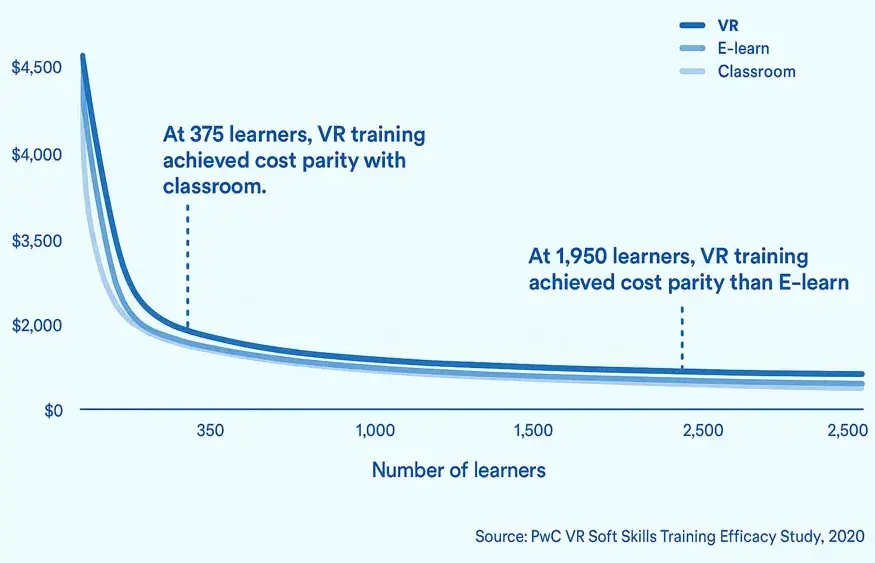
In our own work, VR built competency 65% faster than traditional training at Avangrid. Our Toyota case study shows VR training at work in manufacturing.
To model the numbers for your own team, use the VR training ROI calculator or read the ROI playbook.
How to budget for VR training
- Pick one procedure to start. Choose one that is high-risk, hard to practice for real, or taught to a lot of people.
- Check for a pre-built module first. If one exists, licensing it is the fastest and cheapest way to prove the concept.
- Gather what you already have. CAD or BIM files, procedure documents and site photos all reduce build costs.
- Budget your team’s time. Name a project owner and book subject matter experts for reviews.
- Plan the whole lifecycle. Include headsets, the platform, integrations and maintenance at 10 to 15% of build cost per year.
- Set your KPIs before you build. Time to competency, error rates, incidents or onboarding time, so you can show results.
- Run a pilot, then scale. Prove adoption with one team or site, then expand and reuse your content across roles and locations.
Cut costs, not corners: the VR Vision advantage
Our in-house team and reusable development toolkit let us deliver high-quality VR training faster and for less than traditional approaches. Our tools and workflows can reduce development time and costs by up to 60%.
Frequently asked questions
How much does VR training cost?
A custom VR training project averages about $120,000 CAD. A custom 3D module costs $65,000 to $120,000, an interactive 360 video module $30,000 to $60,000, and a pre-built module license $1,000 to $15,000 per module per year. A starter program of six licensed modules plus the training platform costs about $75,000 in year one.
Is VR training cost-effective?
Usually, once enough people are trained. PwC found VR training reached cost parity with classroom training at 375 learners and with e-learning at 1,950 learners. VR also cuts travel, instructor time and equipment downtime, and lets people practice dangerous tasks without risk.
How long does it take to build VR training?
Licensed pre-built modules can be in the field within 1 to 2 months of signing. A custom build reaches a working pilot in 3 to 4 months and a production release in about 5.5 months.
How much do VR headsets cost for training?
An enterprise headset package costs about $1,000 per headset, including the standalone headset, case, shipping and device management enrolment. Plan for about one headset per 30 learners.
What are the disadvantages of VR training?
The upfront cost is higher than classroom or e-learning, and you need to manage headsets, charging and hygiene. Some learners feel motion discomfort in their first sessions. Programs also stall when the training is never made mandatory or loses its internal champion, so plan for adoption as carefully as the build.
How can I budget for VR training?
Start with one procedure, check whether a pre-built module already exists, and gather any CAD files you have. Budget for headsets, the platform, integrations, maintenance at 10 to 15% of build cost per year, and your own team’s time. Then run a pilot before you scale.
Get a real number for your program
Book a free VR training cost assessment
Tell us about the procedures you want to train. We reply within 24 hours and follow up with a fixed-price pilot proposal.
Sources
- VR Vision Group, Industrial VR Training Buyer’s Guide, 2026 list pricing and project plans.
- PwC, The Effectiveness of Virtual Reality Soft Skills Training in the Enterprise.
- VR Vision Group, Avangrid case study.
Keep reading