
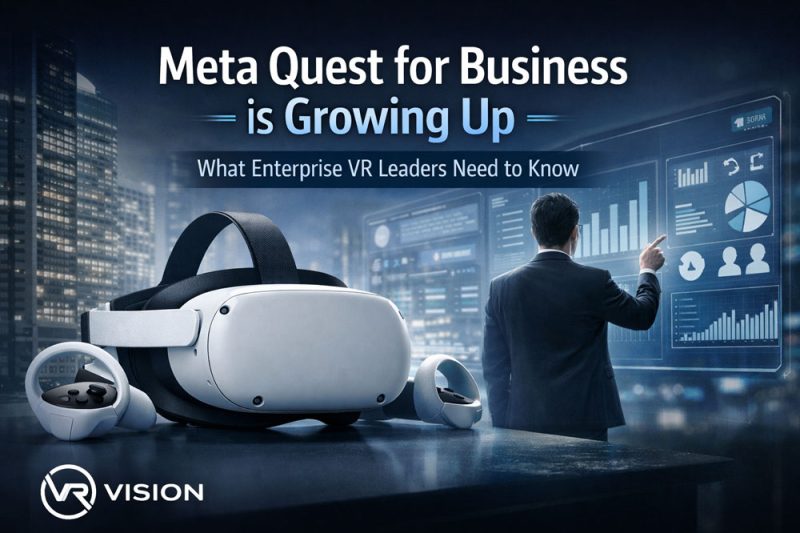
Meta Quest for Business: What’s Changing and Why It Doesn’t Disrupt Serious XR Programs
Meta has confirmed upcoming changes to its enterprise XR offerings, effective February 20, 2026. Predictably, this triggered concern across organizations running XR at scale.
Short answer: nothing breaks.
Long answer: this is a structural shift, not a retreat, and enterprise deployments remain safe, supported, and viable for years.
Here’s how we see it from the field. Lets dive in (headset optional).
What’s Actually Changing
Meta is sunsetting sales of certain enterprise SKUs — not the ecosystem
Starting February 20, 2026, Meta will stop selling:
- Horizon Managed Services (HMS) licenses
- Enterprise / Business Meta Quest SKUs:
- Meta Quest 3 512GB (SK-1000934-01)
- Meta Quest 3S 256GB (SK-1000945-01)
- Meta Quest 3S 128GB (SK-1000940-01)
- Horizon MS for Work (1-Year)
- Horizon for EDU (1-Year)
This applies only to new purchases. Existing deployments are untouched.
The Quiet Upgrade: HMS Becomes Free
From February 20, 2026 onward:
- Horizon Managed Services becomes free for organizations already using it
- No migrations
- No reconfiguration
- No action required
From an enterprise standpoint, this is a net positive: lower operating cost, same management capability.
Long-Term Support Is Locked In
Meta has confirmed:
- Horizon Managed Services will be supported through January 4, 2030
- Applies to Meta Quest 3 and Quest 3S
That’s four+ years of guaranteed operational runway—longer than most enterprise hardware refresh cycles.
What This Signals (and What It Doesn’t)
This is simplification, not exit
Meta has been steadily collapsing enterprise-specific SKUs into a cleaner model:
- Consumer hardware
- Enterprise-grade management
- Unified platform strategy
Going forward, new XR deployments will typically use:
- Consumer Meta Quest 3 / 3S devices
- Horizon Managed Services for device control and governance
This makes hardware easier to source globally while keeping enterprise controls intact.
XR programs don’t stall. Procurement just gets simpler.
What This Means for New XR Programs
From February 20, 2026 onward:
- New deployments use consumer Quest devices
- HMS remains available for fleet management
- Enterprise support continues
- No functional loss for training, safety, or education use cases
From a delivery perspective, the impact is minimal—especially when XR programs are architected correctly.
The Reality Most Vendors Won’t Say Out Loud
Device management alone has never been the success factor in enterprise XR.
What actually determines ROI at scale:
- Content quality
- Training analytics
- Remote visibility into in-headset users
- Governance across users, devices, and locations
This is where platforms like Vision Portal matter—providing:
- Advanced analytics across users and courses
- Real-time remote assistance for in-headset learners
- Centralized visibility into content, devices, and usage
Hardware is necessary. Infrastructure is decisive.
Bottom Line
- Existing deployments are safe
- HMS is free
- Support runs through 2030
- New projects remain viable
- Meta Quest is still enterprise-grade—when paired with the right platform
XR didn’t get riskier. It got more standardized.
Want to see how this looks in a real enterprise deployment?
🎯Book a demo and see how VR Vision develops XR programs that scale with your organization.