
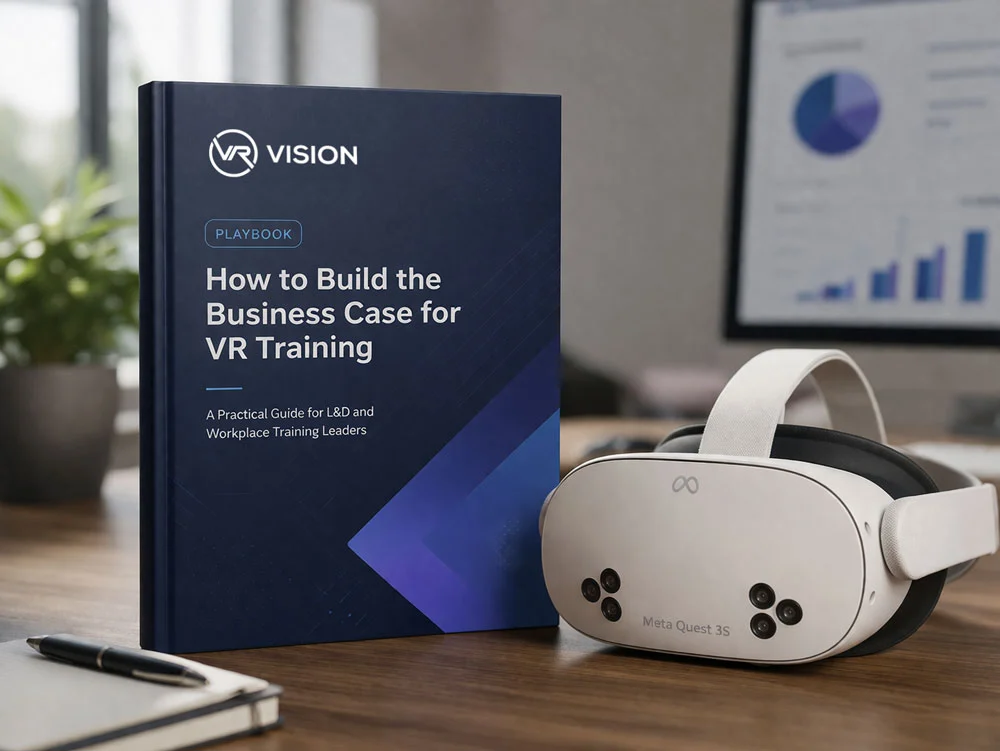
The step-by-step framework for L&D, safety, and operations leaders who need to move VR training from "interesting idea" to funded initiative. Get budget approval from people who haven't put on a headset.
The fastest way to kill a VR proposal is to lead with the headset. Executives don't fund technology — they fund solutions to problems they already worry about. Before you write a single slide, identify the operational pain point VR will solve.
High-risk procedures where training errors have catastrophic or expensive consequences. LOTO, confined space, high-voltage switching, fall protection.
Roles where new hires take too long to get productive. Especially critical where retiring workers take decades of tribal knowledge with them.
Multi-site operations where training quality varies by location, instructor, or scheduling. Audit findings flagging inconsistent delivery.
Travel, facility rental, equipment downtime, instructor hours. These costs are dispersed across budgets and almost always underestimated.
Modern learners respond to immersive, interactive experiences. VR trainees are up to 40% more engaged than those in traditional programs.
A VR training initiative touches multiple budget holders. Each one filters your proposal through a different lens. Here's how to speak to each of them:
| Stakeholder | Primary Concern | Lead With |
|---|---|---|
| CFO / Finance | Payback period, cost per learner | ROI model, incident cost avoidance, per-learner cost comparison |
| VP Operations | Scheduling, error reduction | Can we train night shift without pulling them off rotation? |
| Head of Safety / EHS | Incident rates, regulatory exposure | Tie VR to OSHA recordable reduction or audit gap closure |
| IT / Security | MDM, network, data, SSO/LMS | Standalone headsets, ArborXR MDM, SCORM/xAPI integration |
| HR / L&D | Training effectiveness, scalability | Vision Portal analytics, completion tracking, survey tools |
Explore Vision Portal: Real-time analytics & trainer dashboard
This is the step most proposals skip — and it's the most persuasive. Don't just pitch what VR will deliver. Make the cost of the status quo concrete and uncomfortable.
* Illustrative example: 500-person utility workforce. Your numbers will vary. Use the ROI Calculator for your organization.
Connect the problem (Step 1) to the money (Step 3) and show what changes with VR. A credible ROI model has four layers:
Compare per-learner costs under current program vs. VR. Include hardware amortization, content development, hosting, and M&S. The per-learner cost advantage typically ranges from 40–60% — and improves every year as the content library grows.
If current ramp-up is 12 weeks and VR cuts it to 6, quantify those 6 weeks in supervision hours saved, errors avoided, and productivity gained. Avangrid saw training completed 65% faster with VR.
This is where the largest numbers emerge. If VR reduces incident rate by 10–20%, multiply by average cost per incident. A single serious incident can cost $500K–$2M+. One avoided incident pays for the entire program.
Content built once deploys across sites, shifts, and roles. A base electrical safety module can feed utilities, manufacturing, and emergency response. Year 1 is the investment. Year 2+ is where the leverage shows.
* Illustrative model based on 500-person workforce. VR investment front-loaded in Year 1; traditional costs compound annually.
You don't need to boil the ocean. The strongest business cases start with a single use case that checks all five of these boxes:
Faster onboarding for wind turbine maintenance. 50+ modules deployed across US facilities.
Annual training savings. 1,000+ technicians trained on substation operations.
Annual savings from immersive forklift maintenance training across US/Canada.
Renewable wind technicians trained globally on crane certification.
Every business case gets pressure-tested. Prepare for these before your presentation, not during it:
Here's the format that works for internal approval at enterprise organizations. Keep it under 10 pages. The appendix can be as long as needed.
The problem, proposed solution, expected ROI, and the ask. A CFO should understand the full picture from this page alone.
Current state data: what training costs today, what it's failing to deliver, and the risks of not acting.
What you're recommending, how it works, and why now. Pilot scope, timeline, and vendor selection rationale.
Conservative and realistic scenarios. Include payback period. Reference ROI Calculator output.
Phases, timeline, and resource requirements. Typical pilot: 4–6 months from kickoff to deployment.
Address IT, adoption, and budget risks with specific mitigation actions for each.
Supporting data, case studies, objection responses, vendor credentials.
The pilot is your proof of concept. Everything you've promised gets validated here.
* Composite benchmarks from VR Vision deployments and PwC 2020 VR Training Study. Results vary by use case.
After the pilot (typically 60–90 days), produce a Pilot Results Report that includes actual vs. projected performance on every success metric, qualitative feedback from trainees and supervisors, cost actuals vs. budget, and a clear recommendation for Phase 2 expansion.
Once the pilot validates the model, scaling is where the economics take off. Content gets reused and adapted across roles and sites. New modules build on existing assets, cutting development time and cost for each addition.
Centralized platforms matter most at scale. Vision Portal gives you a single pane of glass to manage devices, push updates, track analytics, and control access across your entire deployment — whether it's 10 headsets at one site or 500 across a continent.
Every resource you need to build, present, and defend your business case: