

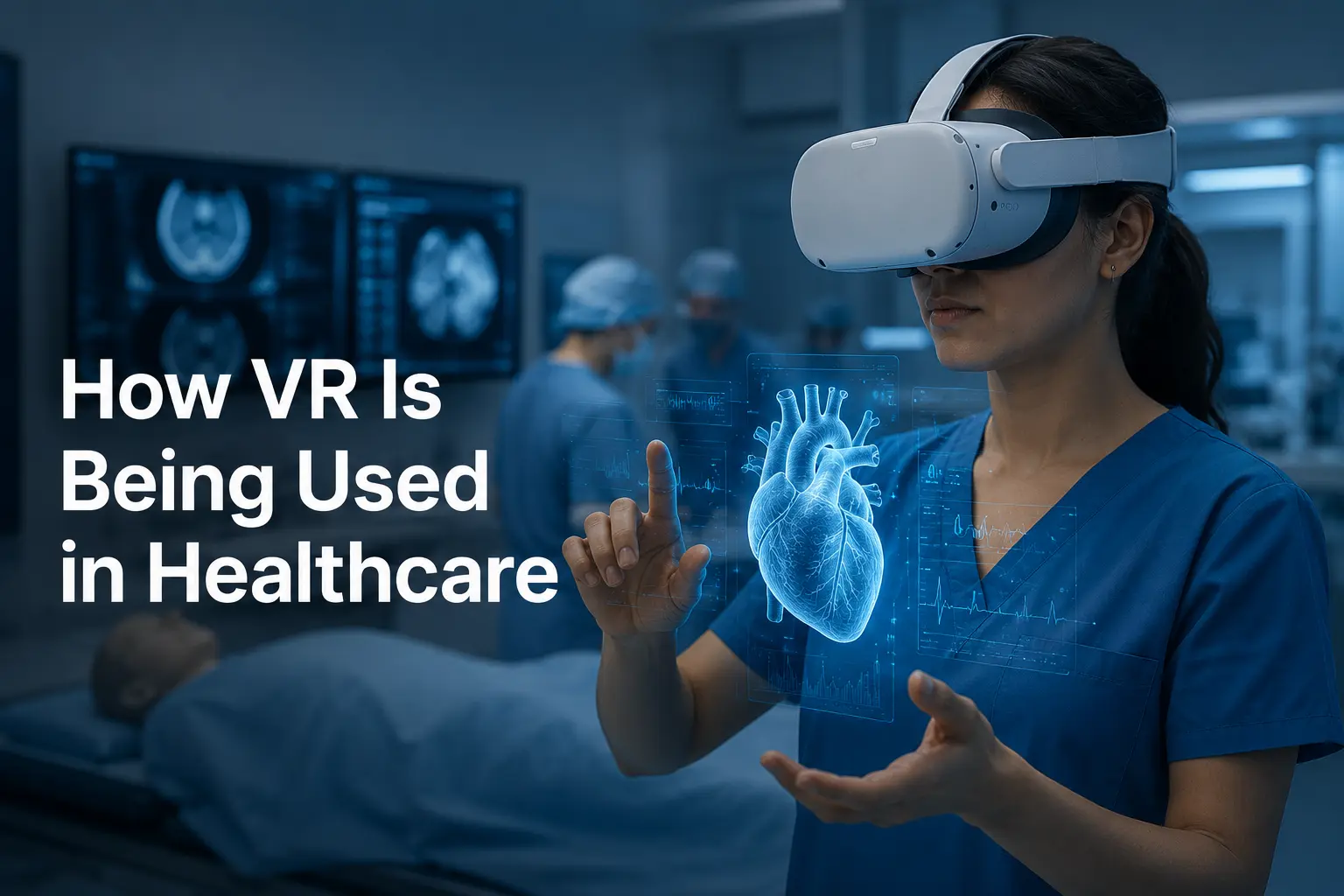
- The global VR-in-healthcare market is forecast to grow from roughly $5.6B in 2025 to $7.6B in 2026, on track to hit $66B+ by 2034 — one of the fastest CAGRs in all of digital health.
- VR is no longer a "future of medicine" pitch. It's FDA-authorized (AppliedVR's RelieVRx for chronic back pain), used in cataract surgery at SightMD with Apple Vision Pro, and clinically proven to 3x surgical training performance in randomized trials at UCLA, Johns Hopkins and University of Illinois.
- The four highest-value clinical use cases right now: surgical training and rehearsal, pain management, mental health and PTSD therapy, and medical education.
- For enterprise health systems, the question has shifted from "does VR work?" to "how do we deploy it at scale?"
When this article was first published in 2017, the VR-in-healthcare conversation was largely theoretical. Researchers were excited. A few experimental programs were running. And the practical examples — Google Cardboard heart surgeries, "SnowWorld" for burn patients — were extraordinary precisely because they were rare.
That world is gone. In 2026, virtual reality in healthcare is regulated medicine. It's reimbursable in some jurisdictions. It's in operating rooms, behavioral health clinics, medical schools, and patient bedsides — backed by hundreds of peer-reviewed studies and a market growing at roughly 31% CAGR.
This is the updated, evidence-based picture of where VR actually sits in healthcare today, where it's working, where it isn't, and what's coming next.
What Is VR in Healthcare?
Virtual reality in healthcare is the use of immersive, computer-generated environments — delivered through head-mounted displays — to train clinicians, treat patients, plan surgeries, manage pain, and deliver therapy. It spans both clinical applications (patient-facing care) and operational ones (medical education, surgical rehearsal, staff training).
Modern healthcare VR breaks down into two camps: VR as a therapeutic (the headset is the treatment) and VR as a tool (the headset helps a clinician do something better). Both are growing fast, but they have very different regulatory paths and buying cycles. Therapeutics need FDA clearance. Training tools generally don't.
Where VR Is Actually Being Used in 2026
Surgical Training & Rehearsal
Platforms like Osso VR, FundamentalVR and Precision OS train surgeons on procedures with measurable performance gains — used by Johnson & Johnson, Stryker, Zimmer Biomet and Medtronic.
Pre-Operative Planning
3D models built from a patient's own MRI and CT data, viewable in VR before the procedure. Particularly transformative in pediatric cardiology, neurosurgery and complex orthopedics.
Pain Management
FDA-authorized therapeutics like RelieVRx (chronic back pain), plus widespread in-hospital deployment for acute pain, burns, IV insertions, and labor and delivery.
Mental Health & PTSD
USC's Bravemind VR exposure therapy is now deployed across the VA system. Mental health is forecast to be the fastest-growing healthcare VR segment through 2035.
Medical Education
Over 60% of medical schools now integrate immersive simulation tools. Cadaver-free anatomy labs, digital twin patients, and standardized scenarios replacing inconsistent rotations.
Rehabilitation & Therapy
Stroke recovery, vestibular rehabilitation, physical therapy gamification — VR-delivered programs that drive adherence and produce objective movement data clinicians can act on.
Surgical Training: The Strongest Clinical Evidence
The use case with the most rigorous clinical validation is surgical training. And the data is hard to argue with.
A 2019 randomized study at UCLA's David Geffen School of Medicine compared surgical trainees who used Osso VR against trainees who used a standard technique guide. The VR group performed the same procedure 230% better and 20% faster, with 38% more procedure steps completed correctly.
A follow-up randomized trial at the University of Illinois College of Medicine pushed that gap further — VR-trained residents were 3x more likely to complete the procedure successfully, with a 300% improvement in accuracy. Johns Hopkins replicated the pattern for slipped capital femoral epiphysis fixation. Across the literature, the direction of the evidence is consistent: VR training produces meaningfully better surgeons, faster.
Why VR works for surgery specifically
Surgical skill is built through repetition of motor sequences under cognitive load. The bottleneck in traditional training isn't curriculum — it's case volume. VR removes that bottleneck. A trainee can run a complex procedure 30 times in a weekend instead of waiting 6 months for live cases. The result: shorter learning curves, fewer errors on first live procedures, and standardized competency benchmarks that didn't exist before.
The Apple Vision Pro Inflection Point
Two years ago, the standard healthcare headset conversation centered on Meta Quest. That changed in 2024 and accelerated through 2025.
In October 2025, ophthalmologist Dr. Eric Rosenberg at SightMD performed the world's first cataract surgery assisted by Apple Vision Pro, using the ScopeXR platform to fuse live microscope feeds with pre-operative diagnostic data inside the headset. By April 2026, hundreds of cataract procedures had been performed with Vision Pro assistance.
Beyond the operating room, Mayo Clinic uses Vision Pro for surgical rehearsal and emergency response training. Boston Children's Hospital built an app called CyranoHealth that trains nurses on infusion pump operation. Cedars-Sinai deploys it for clinician empathy training — letting doctors experience conditions from the patient's perspective. Stryker's myMako app lets orthopedic surgeons visualize and review surgical plans in 3D.
The pattern: Vision Pro hasn't replaced consumer headsets in healthcare. It's opened a new tier — high-precision, high-cost applications where the device's resolution and sensor fusion change what's clinically possible.

Pain Management: VR Becomes Regulated Medicine
The most significant regulatory milestone in healthcare VR came in November 2021, when the FDA authorized AppliedVR's RelieVRx (originally EaseVRx) — the first VR-based prescription therapeutic for chronic lower back pain. It's an 8-week, 56-session at-home program built around cognitive behavioral therapy principles, mindfulness, and pain education.
As of 2025, RelieVRx has been used by more than 60,000 patients across 200+ leading health systems. A 2025 study in npj Digital Medicine found significant long-term pain reductions sustained out to 12 months post-treatment — durable, drug-free pain management at scale.
The acute pain story is just as strong. Cedars-Sinai's Brennan Spiegel, MD has now run three randomized studies on VR for inpatient pain involving over 300 hospitalized patients. The headline result: a 24% pain reduction in patients who used therapeutic VR, with effects persisting up to 72 hours after a single session.
"We don't need more science at this point to justify deploying VR in the hospital. We've got enough evidence now to begin using this in the inpatient environment. The challenge will be staffing it, scaling it, paying for it — but science is no longer the challenge."
— Brennan Spiegel, MD, MSHS — Director of Health Services Research, Cedars-Sinai
What about burns? "SnowWorld" — the original VR pain distraction program created at the University of Washington's HITLab — is now one program in a much broader category. Burn units across the US, UK and Europe routinely use immersive VR for wound care, dressing changes and graft procedures. The mechanism is the same as Spiegel's research: VR competes for the brain's attentional bandwidth, leaving less available for pain processing.
Mental Health: The Next Major Wave
Pain was the first FDA-authorized VR use case. Mental health is shaping up to be the largest.
Across multiple 2026 market forecasts, the mental health therapy segment is consistently flagged as the fastest-growing healthcare VR application — outpacing surgery, training and rehab combined.
The flagship program is Bravemind, developed at the USC Institute for Creative Technologies. It's a clinician-controlled VR exposure therapy system for PTSD with 14 customizable virtual environments. In the largest randomized clinical trial to date (Difede, Rothbaum and Rizzo, 2022), Bravemind matched the best-in-class evidence-based PTSD treatment — and outperformed it in patients with co-morbid major depression. Seventy-six percent of incoming patients preferred VR therapy over traditional methods.
The VA has been rolling out Bravemind nationally, with training programs for VA clinicians underway. International adoption (Denmark, Australia, NATO partners) is following.
Beyond PTSD, the strongest mental health VR evidence is in:
- Phobia treatment — fear of flying, heights, public speaking, social anxiety — with structured graduated exposure
- Generalized anxiety disorder — relaxation, biofeedback, breathing protocols delivered immersively
- OCD exposure and response prevention
- Addiction craving management — exposure to triggers in controlled settings
Medical Education Is Quietly Being Rebuilt
The deepest long-term impact of VR in healthcare may not be in patient care at all. It's in how the next generation of clinicians learns.
More than 60% of medical schools now integrate immersive simulation tools. Cadaver-based anatomy — long the gold standard, but expensive, inconsistent and ethically complicated — is increasingly supplemented or replaced by detailed VR anatomy labs and "digital twin" patients. Nursing schools use VR for IV insertion, medication administration, code blue response, and patient communication.
The economics matter. A high-fidelity manikin costs $50,000+ and reproduces one scenario. A VR headset costs under $1,500 and can deliver hundreds of standardized scenarios with objective performance data attached to every trainee. For schools and health systems trying to scale clinician training in a workforce shortage, that math is decisive.
The Honest Limitations
This isn't a hype piece, so the limitations deserve attention.
Hardware is still a friction point. Most advanced VR headsets weigh over 450 grams — uncomfortable for long therapy sessions, particularly for elderly patients or post-op recovery. Hygiene protocols between patients remain operationally annoying. Battery life caps session length.
Reimbursement is uneven. RelieVRx has Medicare coverage in certain pathways and is in active negotiation with commercial payers, but most VR therapy is still paid out-of-pocket or absorbed as a hospital operating expense rather than billed.
Clinical validation is procedure-specific. Strong evidence for orthopedic surgical training doesn't transfer automatically to cardiac surgery. The market is still earning its evidence one specialty at a time.
Integration with EHR and existing hospital IT is hard. The training analytics and patient outcome data generated by VR systems need to land somewhere clinicians actually look — and that integration work is non-trivial.
None of these are deal-breakers. All of them are areas where the next two to three years of investment will compound.
What's Next: AI, Digital Twins, and Ambient Healthcare VR
Three trends to watch through 2027.
AI-personalized therapy. The current generation of VR therapeutics delivers the same protocol to every patient. The next generation will adapt — adjusting difficulty, narrative, sensory intensity and pacing in real time based on biometric signals, eye tracking and physiological response. AppliedVR, Bravemind's next iteration, and several stealth startups are all building toward this.
Patient digital twins. Combining a patient's own imaging data (MRI, CT, ultrasound) with VR rendering to create a navigable, accurate 3D model for surgical planning is rapidly becoming standard for complex pediatric and neurosurgical cases. The cost of building these has collapsed; the question is now workflow integration, not feasibility.
Ambient and lightweight form factors. The Vision Pro is the last of the heavy headsets that matters. The next wave — Apple's rumored lighter smart-glasses, Meta's Orion successor, and a class of medical-specific HMDs — will be wearable for full clinical shifts. When the headset stops being something a clinician puts on for a 10-minute task and becomes something they wear ambiently, the use cases multiply by an order of magnitude.
Frequently Asked Questions
Yes, for specific indications. AppliedVR's RelieVRx received FDA De Novo authorization in November 2021 as a prescription therapeutic for chronic lower back pain. It remains the first and most widely used FDA-authorized VR medical device. Additional VR therapeutics are working through FDA clearance pathways for anxiety, ADHD, and post-surgical pain.
Multiple randomized peer-reviewed studies show VR-trained surgeons perform 230–306% better than peers using traditional study guides, complete procedures 20% faster, and execute 38% more procedure steps correctly. The strongest evidence is in orthopedic surgery, but the same patterns are emerging across general surgery, ophthalmology and neurosurgery.
The most common enterprise headsets in healthcare today are the Meta Quest 3 and Meta Quest 3S for training and patient therapy applications, Pico 4 Ultra Enterprise for managed deployments, and Apple Vision Pro for high-precision surgical and clinical applications where resolution and spatial fidelity justify the price point.
The global VR-in-healthcare market is estimated at approximately $7.6 billion in 2026, projected to grow at a 30%+ CAGR through 2034 to reach $66 billion or more. North America accounts for roughly 36–42% of the global market, with the United States as the largest single national market.
Yes. Multiple randomized clinical trials have shown statistically significant pain reduction with therapeutic VR, including a 24% drop in self-reported pain scores in hospitalized patients at Cedars-Sinai. FDA-authorized RelieVRx has demonstrated durable pain reductions in chronic back pain patients sustained at 12 months post-treatment.
Building Healthcare VR Training That Scales
VR Vision builds enterprise-grade immersive training simulations for healthcare, life sciences and safety-critical industries. Trusted by Johnson & Johnson, Avangrid, Enel, Siemens, Toyota and Toronto Hydro to deliver training that meets strict compliance and operational standards.
Book a Discovery Call