

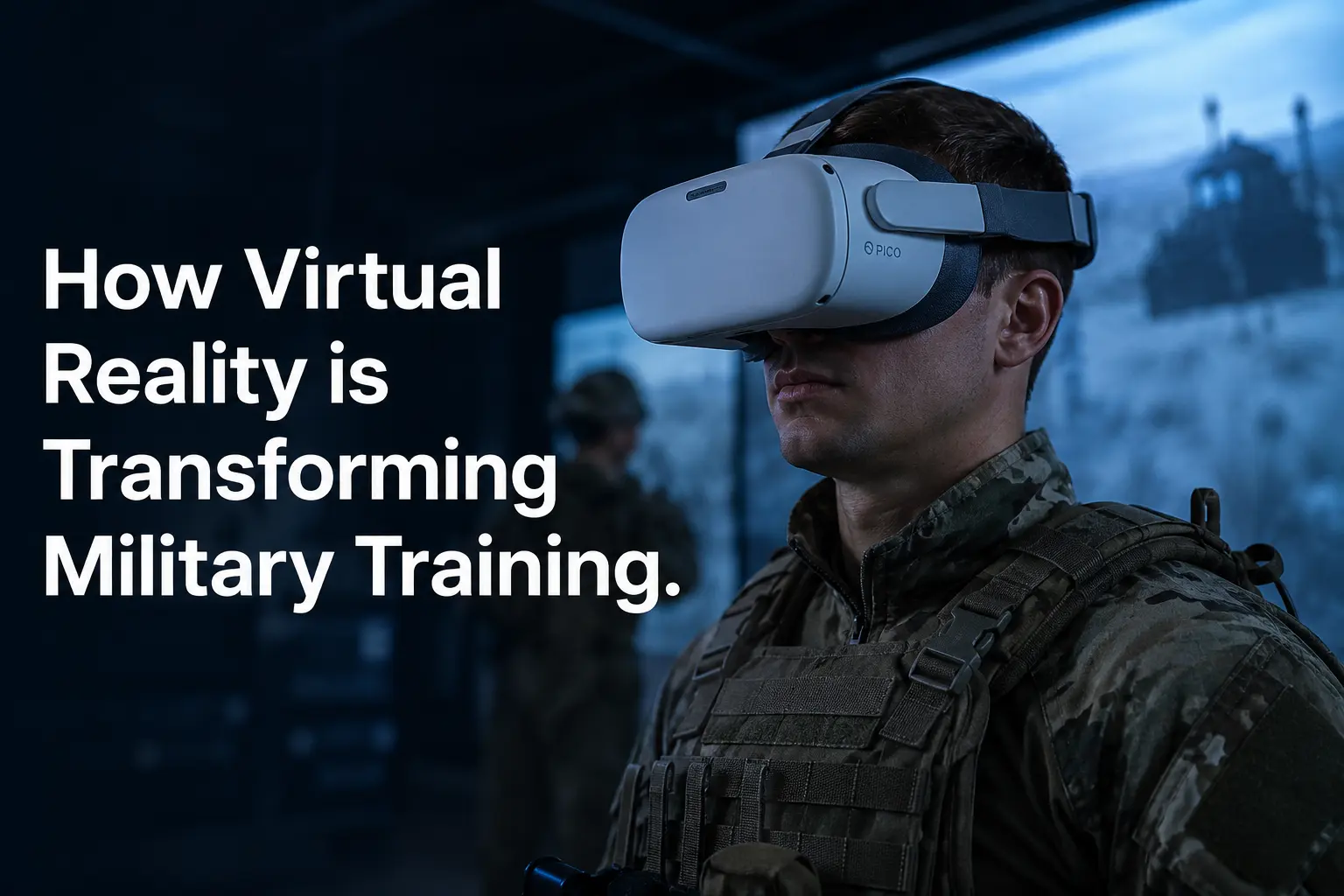
- The US Army dropped the troubled IVAS headset and restarted as Soldier Borne Mission Command (SBMC). Prototype awards in September 2025 topped $350M, and the Rangers tested the first units in August 2026.
- The biggest proven wins aren't the flashy combat simulators. They're in schoolhouses, maintenance bays and medic training, where VR cuts course time and travel.
- The Marine Corps communications school now finishes a 45-day course in about 37 days and saves $1.8M a year in travel by moving refreshers into virtual training.
- The lessons carry straight over to industry: comfort, simple controls and real performance data decide whether a VR program sticks.
Some skills you can pick up by trial and error. Others you only get one real attempt at. Most military training sits in the second group, which is why armed forces were among the first to pay serious money for simulation.
What has changed is where that simulation happens. It used to mean a room-sized simulator at a single base. Today it increasingly means a standalone headset, a laptop, or a display clipped to a soldier's helmet. The hardware got lighter, the software got smarter, and the programs got more specific about what they are actually trying to fix.
Here is where things stand across the US services, what the results look like so far, and what any organization running safety-critical training can take from it.
From IVAS to SBMC: the Army's second attempt
The Army's Integrated Visual Augmentation System was supposed to put a mixed reality display on every close-combat soldier. It was built on Microsoft's HoloLens and carried a ceiling of up to $22 billion. Soldiers reported discomfort and nausea, and in early 2025 Microsoft handed the program to Anduril.
The Army then reset the effort as Soldier Borne Mission Command. In September 2025 it awarded prototype contracts worth $159 million to Anduril and $195 million to Rivet. Anduril brought in Meta as a partner.
The first round of testing wrapped up with the 75th Ranger Regiment in August 2026. For phase two, Anduril redesigned the system with Meta and Oakley's Standard Issue brand: integrated digital night vision, 4K displays, a heads-up display of about 110 grams, and a controller that takes two actions where the old one took 21 button clicks. Phase two testing is planned for early 2027, with a possible production award in fiscal 2028.
The takeaway is simple. The first program didn't struggle because the idea was wrong. It struggled because the headset was uncomfortable and hard to use. The second attempt is being judged on weight, comfort and how few steps it takes to do anything.
Why this matters outside defense
Every enterprise VR rollout runs into the same questions the Army did: will people keep the headset on, can a trainee use it without an instructor at their shoulder, and can IT manage hundreds of devices securely? The technology is rarely the blocker. Adoption is.
Where VR is actually being used today
Combat medicine
At Womack Army Medical Center, medics practice Tactical Combat Casualty Care in VR with hand tracking, working through realistic casualty scenarios before they ever touch a patient.
Vehicle crews
In May 2026 the Marine Corps awarded $5.1M for an Amphibious Combat Vehicle gunnery trainer where the whole crew trains together. The same vendor had already fielded 81 driver simulators.
Technical schoolhouses
The Marine Corps Communication-Electronics School uses VR headsets and a virtual network platform so students practice on equipment before handling the real, and expensive, radios.
Shipboard training
The Navy's training systems division turned a legacy touchscreen trainer into a VR model of a Los Angeles-class submarine machinery room that sailors can run on board.
Pilots
Red 6's augmented reality system puts virtual adversaries into a pilot's view during real flights. It runs on the T-38 and MC-130, is being added to the F-16, and flies with the UK's Hawk T2.
Performance data
New platforms such as VRAI and Varjo's HEAT system record heart rate, eye movement and cognitive load, so instructors can see why a trainee made a call, not just what they did.
"By the time a soldier faces a real casualty, they've 'been there, done that' multiple times in VR."
Don-Emeil Watson, Medical Simulator Operations Specialist, Womack Army Medical Center
That line explains most of the value. The first time you do something under pressure is when you're most likely to freeze or skip a step. VR lets people get that first time, and the second and tenth, out of the way somewhere it doesn't matter.
The results that hold up
A lot of military VR coverage leans on vendor claims. The most useful numbers come from programs that report their own results.
- Faster courses. At the Marine Corps Communication-Electronics School, students now finish the 45-day Basic Electronics Course in an average of 37 days, and grade point averages rose about 2%, according to the school's commander.
- Less travel. Running staff refresher courses virtually cut the school's temporary duty travel bill from $2.3M to about $350K a year.
- Less broken equipment. The same school reports fewer radios damaged by students, because they practice in VR first.
- A bottleneck worth attacking. A February 2026 Proceedings article estimates that congestion in Navy training pipelines costs around $400M a year. Taking training to the ship is one way to clear it.
- The civilian benchmark. Outside defense, PwC's study of VR training found learners trained up to four times faster than in a classroom and felt 275% more confident applying what they learned.
What's next
Three trends are shaping the next few years.
Adversaries that think. Scripted scenarios are giving way to AI-driven opponents and role players that react to what the trainee does. The Marine ACV trainer is an early example.
Training that measures the person, not just the result. Eye tracking, heart rate and stress data are moving from research labs into training platforms. Used well, they tell an instructor who is ready and who is just getting lucky.
Training on the hardware people already carry. The Army's Synthetic Training Environment is fielding to combat training centers, and the Navy is pushing VR and handheld trainers onto ships. The goal is to practice where the work happens instead of waiting for a seat at a schoolhouse.
What industrial training teams can take from this
Defense budgets are bigger, but the problems are familiar to anyone training utility crews, plant technicians or field service teams.
- Comfort and simplicity come first. If the headset is heavy or the controls are confusing, people stop using it. Standalone headsets like the Meta Quest 3S and PICO 4 Enterprise, with hand tracking, remove most of that friction.
- Start with procedures and maintenance. The clearest military wins are in technical schools and maintenance training, not combat simulation. The same is true in industry.
- Measure more than completion. Track errors, sequence and time on task, so you can show who is ready for the field.
- Plan for fleet management. Hundreds of headsets need device management, secure sign-on and a way to push updates.
Building VR training for safety-critical work
VR Vision builds VR training for procedures, maintenance and safety-critical work in energy, utilities, manufacturing and automotive. Trusted by Avangrid, Enel, Siemens, Toyota and Toronto Hydro, with 100,000+ technicians trained.
Book a Discovery Call