

Most training programs have the same weak spot. People sit through the course, pass the quiz, and then meet the real equipment for the first time on the job. That first real attempt is where mistakes, injuries and rework happen. VR training moves that first attempt into a headset.
We’ve spent years building VR training for energy, utilities, manufacturing and automotive teams, including programs for Toyota, Avangrid, Toronto Hydro and Siemens Gamesa. These are the ten benefits of VR training that matter most once a program moves past the pilot and becomes part of how people learn, backed by research and by results from real deployments.
The 10 benefits at a glance
1. Higher engagement and focus
A headset blocks out the room. No inbox, no phone, no side conversations at the back of the classroom. Trainees are inside the task, and they have to act to move forward.
Doing, not watching
In a VR module the trainee picks up the tool, opens the panel and works through the steps. That’s very different from watching a video of someone else doing it. In PwC’s study of VR training, VR learners were up to four times more focused than e-learners and 1.5 times more focused than classroom learners. They also felt 3.75 times more emotionally connected to the content than classroom learners.
2. Realistic practice without the risk
You can’t let a new hire practice on a live switchgear panel or a running production line. In VR you can recreate the actual site, the actual equipment and the actual procedure, then let people practice as often as they need.
Mistakes cost nothing
Skipping a lockout step in VR ends a scenario, not a career. Trainees can try something, get it wrong, see what happens and try again. That’s how immersive learning builds confidence people carry onto the job site. PwC found VR learners were up to 275% more confident to act on what they learned, a 40% improvement over classroom learners.
3. Faster training at a lower cost
There’s an upfront cost to building VR modules and buying headsets. The payback comes from what you stop spending: travel to training centers, instructor hours, pulled equipment and downtime while people wait for a class seat.
Faster time to competency
PwC found VR learners finished training up to four times faster than classroom learners: 29 minutes on average, compared with two hours in the classroom and 45 minutes for e-learning. Our own deployments show the same pattern on technical work. Avangrid‘s maintenance technicians reached competency 65% faster than with traditional training, and Toronto Hydro cut technician time-to-train by 30%.
Lower cost per learner as you scale
A module costs the same to build whether 50 people use it or 5,000, so the cost per learner keeps falling. PwC calculated that VR training reaches cost parity with classroom training at 375 learners and becomes 52% more cost-effective at 3,000 learners. Toyota Material Handling trained more than 10,000 dealer technicians across 200+ dealerships in VR and saves $1.5M a year.
If you want to model it for your own team, try the VR training ROI calculator or read how to build the business case for VR training.
4. Consistent training across every site
Standalone headsets like the Meta Quest 3 and 3S need no PC and no cables. You can ship them to a remote site, a depot or a new plant, and people can train there instead of traveling to a central facility.
The same standard everywhere
Every site gets the same procedure, taught the same way. That’s hard to guarantee when training depends on which instructor you get. Siemens Gamesa uses VR to run one crane and hoist training standard across 10 global learning centers.
Managing it all from one place
Once you have dozens or hundreds of headsets, you need a way to run them. We built Vision Portal for exactly that: trainers can launch sessions, watch what trainees see in real time and track results across teams.
5. Better knowledge retention
Doing a task with your own hands sticks better than reading about it. VR lets trainees build that hands-on memory before they touch the real equipment. A 2023 review of 52 studies in Safety Science concluded that VR safety training outperforms traditional training for knowledge acquisition and retention, and a 2022 meta-analysis of 48 studies found a positive effect of VR on learning outcomes.
Repetition without the setup
Running a physical drill ten times means ten rounds of setup and equipment time. Running it ten times in VR means pressing restart. The repetition is what turns a procedure into habit.
6. Safer workplaces
A lot of utility and industrial work, like substation and high-voltage tasks, is dangerous to practice for real. VR lets crews rehearse it with no exposure to the hazard. See how this plays out in substation training and ten jobs where VR training reduces on-the-job incidents.
Ready for the rare emergency
Some events happen so rarely that most workers never practice them: an arc flash, a gas release, a fire in the plant. In VR you can run those scenarios as often as you like, so people know what to do if the day comes.
7. Measurable performance data
A classroom tells you who attended. A VR module can tell you who did the steps in the right order, how long it took, where they hesitated and which mistakes they made.

Finding the gaps
When most trainees miss the same step, you know the procedure or the instruction needs work. When one person keeps struggling, you know who needs more coaching before they head to the field. AI is now making this analysis faster; read how AI is powering VR training analytics.
8. Team and multiplayer training
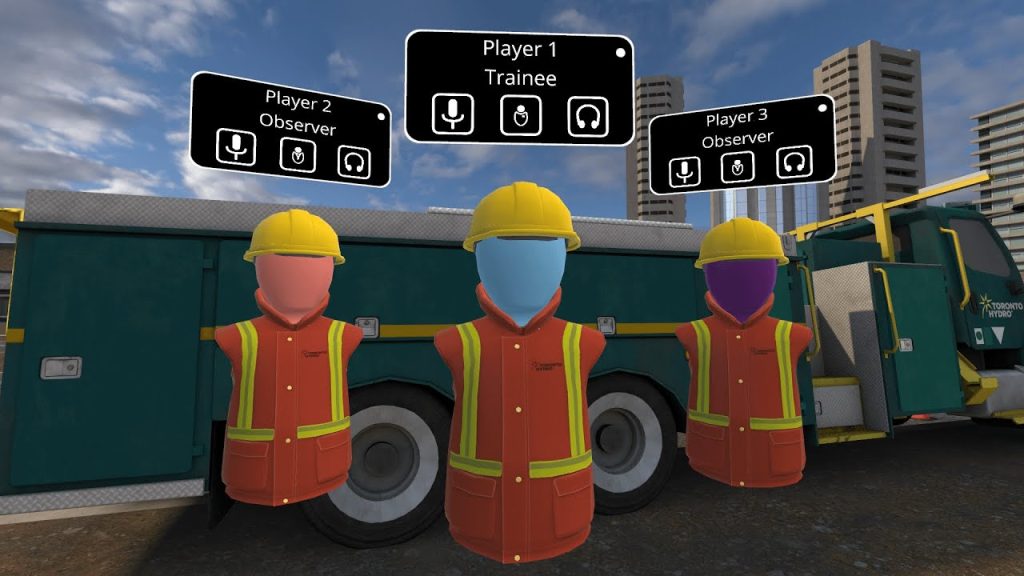
Multiplayer VR puts several trainees in the same virtual space, even if they’re in different cities. Crews can practice a job that needs coordination, like a switching procedure where one person operates and another verifies.
Practicing the handoffs
A lot of incidents happen between people, not at one person’s station. Team scenarios let crews practice the communication and handoffs that make a procedure safe.
9. Training that keeps up with change
Equipment gets replaced, procedures get updated and new people join all the time. VR content can be updated and pushed to every headset, so training stays current without rebuilding a physical training rig.
Faster onboarding for new hires
With experienced workers retiring across energy and manufacturing, getting new hires productive quickly matters more every year. In the U.S. energy sector, 56% of workers have fewer than 10 years of experience. VR gives new hires hours of realistic practice before their first shift. Learn more about VR employee onboarding.
10. Less travel and a smaller footprint
Training people where they work means fewer flights, fewer hotel nights and less time away from the job. It also cuts down on printed materials and the consumables used up in physical drills. Toyota Material Handling trains dealer technicians without shipping a single forklift, and Siemens Gamesa trains crane and hoist skills without the trip offshore.
A lower-carbon training program
For organizations with emissions targets, moving routine training out of central facilities and into headsets is one of the easier reductions to make.
VR training vs. classroom and e-learning: the data
PwC’s study is still the most-cited head-to-head comparison. It tracked about 1,600 new managers who took the same soft-skills course in a classroom, through e-learning or in VR.
| Measure | VR vs. classroom | VR vs. e-learning |
|---|---|---|
| Speed of training | Up to 4x faster | Up to 1.5x faster |
| Focus during training | 1.5x more focused | Up to 4x more focused |
| Emotional connection to content | 3.75x more connected | 2.3x more connected |
| Confidence to act on learning | 40% more confident | 35% more confident |
| Cost parity reached at | 375 learners | 1,950 learners |
| Cost at 3,000 learners | 52% more cost-effective | 8% more cost-effective |
Source: PwC, The Effectiveness of Virtual Reality Soft Skills Training in the Enterprise (2020). Results are from soft-skills training; outcomes on technical training vary by program.
The trade-offs to plan for
VR training isn’t free of friction, and the best programs plan for it from day one:
- Upfront investment. PwC estimated VR content can take up to 48% more upfront investment than classroom content. The savings come with scale and reuse.
- Device management. Headsets need charging, updates and content delivery. Meta ended its Quest for Business program in early 2026, so companies now manage standard Quest headsets with third-party device management tools and platforms like Vision Portal.
- Not every topic fits. VR shines for hands-on, high-risk or hard-to-stage work. Policy updates and simple knowledge checks are still cheaper as e-learning.
- Comfort. Short sessions and seated options keep first-time users comfortable.
We cover these in more depth in the challenges organizations face when deploying VR training.
Where to start
You don’t need to convert your whole curriculum. Pick one procedure that is high-risk, hard to practice for real or taught to a lot of people, and run a pilot. A pilot using pre-built modules can be working in the field within one to two months. If it works, expand from there.
Benefits of VR training FAQ
What are the main benefits of VR training?
The main benefits of VR training are higher engagement, safe practice of dangerous tasks, faster time to competency, lower cost per learner at scale, consistent training across sites, better retention, measurable performance data, team training, easy updates and less travel.
Is VR training more effective than traditional training?
For hands-on and high-risk skills, the evidence says yes. PwC found VR learners trained up to 4x faster than classroom learners and were up to 275% more confident to apply what they learned, and a 2023 review of 52 studies found VR safety training outperforms traditional training for knowledge acquisition and retention.
Is VR training cheaper than classroom training?
It costs more upfront but less per learner as programs grow. PwC found VR reaches cost parity with classroom training at 375 learners and is 52% more cost-effective at 3,000 learners. Toyota Material Handling saves $1.5M a year with its VR program.
What types of training work best in VR?
Training that is hands-on, high-risk, hard to stage or delivered to many people: equipment operation, maintenance procedures, lockout/tagout, emergency response, onboarding and communication skills.
How quickly can a VR training pilot launch?
A pilot using pre-built modules can be working in the field within one to two months. Custom modules built from your own equipment and procedures take longer, depending on scope.
See the benefits of VR training for your team
Get a 30-minute walkthrough of VR Vision’s training modules and Vision Portal, plus a fixed-price pilot proposal for one of your procedures.
Book a demo →Browse case studiesSources
- The Effectiveness of Virtual Reality Soft Skills Training in the Enterprise, PwC, 2020
- Virtual reality for safety training: a systematic literature review, Safety Science, 2023
- A meta-analysis of the effect of virtual reality on learning outcomes, Educational Research Review, 2022
- CEWD workforce gaps report coverage, APPA, Feb 2024
- Meta is shutting down its Quest for Business program, UploadVR, Jan 2026